Adding a Garden Fence for Privacy and Security
Assess Your Garden's Needs and Your Boundary Line
Before you order anything, take a look at your garden and work out what you actually need. Privacy and security are related but not quite the same thing. A fence that blocks the view from next door might not stop someone climbing over. One that is strong enough to resist a push might be low enough to see over. Getting the balance right depends on your garden's layout and the local area.
Start by walking the boundary line. Note where the ground slopes, where trees or sheds are, and which sides face roads or neighbours. If you live in a busy street, a tall fence on the front boundary can cut noise and prying eyes. At the back, you might care more about stopping someone getting in than about blocking a view of fields. Think about which parts of the garden you use most. A seating area or a children's play space probably needs more privacy than a vegetable patch at the far end. This is where good planning for fencing for private gardens begins: knowing what you want to protect and from whom.
Choose the Right Fence Height and Style
Fence height is the first decision because it affects both privacy and security. A fence that is too low will not block sightlines, but one that is too tall can create problems with planning rules or look out of place. In many residential areas, fences up to two metres high are allowed without permission, but it is always worth checking with your local council. A two-metre fence gives good privacy for most gardens and makes climbing over harder for an opportunist.
Closeboard fencing is a popular choice for privacy. It uses vertical boards fixed to horizontal rails, with the boards overlapping or butted tight. This gives a solid surface with no gaps to peep through. The vertical lines also make it harder to climb compared to horizontal slats. If you want a more decorative look, fence panels with a feather-edge or waney edge finish can still be solid but look less industrial. For extra security, consider adding trellis on top. Trellis alone is easy to climb, but when mounted above a solid fence it can add height without making the fence feel like a wall. Just be aware that trellis does not provide the same privacy as a solid panel.

Select Sturdy Fence Posts and Fixings
A fence is only as good as its posts. Even the best closeboard fencing will sag or blow over if the posts are too thin, too short, or set in poor ground. For a standard garden fence, timber posts should be treated softwood or hardwood, with a diameter of at least 75mm to 100mm. For taller fences or exposed sites, go thicker. Concrete posts are an alternative: they do not rot, but they can be harder to work with and may not suit every garden style.
The post hole depth matters. A general rule is that one third of the post's length should be below ground. For a two-metre fence, that means a 2.7 metre post and a hole around 900mm deep. The hole should be about three times the post width. Use Postcrete or a similar fast-setting concrete mix to anchor the posts. Make sure the posts are perfectly vertical while the concrete sets, because a leaning post will throw the whole fence out of line. Check with a spirit level on two sides of the post. If you are setting posts in clay soil, allow for movement when the ground wets and dries. A gravel bed at the bottom of the hole can help drainage.
Install Panels or Boards with Care
With the posts set and fully cured, you can fit the panels or boards. If you are using pre-made fence panels, they usually slot into metal brackets fixed to the posts. This is quick but can be less adjustable if the ground is uneven. Closeboard fencing built from individual boards gives more flexibility. You fix horizontal rails between the posts and then nail or screw each board onto them. This allows you to trim boards to follow a slope or to leave a gap at the bottom for airflow.
Whatever method you use, keep the fence level across its length. Use a string line stretched between the first and last post to check the top edge. If the ground slopes, step the panels or boards rather than angling them, because an angled fence looks odd and creates gaps underneath. Leave a small gap of about 50mm between the bottom of the fence and the ground. This prevents the timber from sitting in damp soil and rotting. It also lets water drain away and small animals pass under rather than digging. If you are worried about gaps, a gravel board or a treated timber strip at the base can close the space without touching the earth.

Add Gate Locks and Privacy Screening
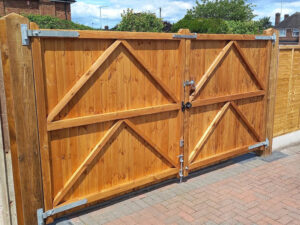
Security is not just about the fence line; the gate is the most obvious entry point. A strong gate with a decent lock is essential. For garden gates, a hasp and staple with a padlock works well, but consider a mortice lock or a latch that can be locked from both sides. If the gate is used daily, choose a self-closing hinge or a spring-loaded latch so it never gets left open. Make sure the gate is hung on hinges that can take the weight, and that the gate posts are extra sturdy because they take more force than intermediate posts.
Privacy screening can be added after the fence is up. If you have a fence with gaps between the boards, or if you want extra cover for a seating area, attach screening fabric or bamboo rolls to the inside face. These are cheap and easy to fit with staples or cable ties. They also provide a windbreak, which can make a garden feel more sheltered. Just remember that screening will reduce airflow, so keep the fence itself well-maintained to avoid trapped moisture leading to rot. For a more permanent solution, plant a hedge or climbers along the fence line. Evergreen shrubs like laurel or privet will thicken the barrier over time and add greenery. Climbers such as ivy or jasmine can be trained up trellis attached to the fence, but they need regular trimming to stop them damaging the wood.
Maintain Your Fence for Long Life
A new fence will last many years if you look after it. Treat timber with a good-quality preservative or paint within the first few weeks of installation. After that, check the fence once a year. Look for loose boards, rusting fixings, or signs of rot at the base of posts. Replace any damaged panels or boards quickly, because a weak spot can spread. Keep vegetation away from the fence line. Ivy and other climbers can trap moisture and speed up decay. If you have a wooden fence, do not let soil build up against it, because that will keep the wood damp and invite rot.
Security checking is also part of maintenance. Test the gate lock and hinges each season. If a post starts to lean, it may need re-concreting or replacing. A fence that is well looked after will serve its purpose for a long time, and the small effort of annual checks saves the cost of a full replacement later.
Final Thoughts on Garden Fencing Derby
When you are considering fencing for private gardens in an area like Derby, the local climate and soil type play a part in what works best. Clay soils can make post setting trickier, and wet winters mean timber needs good treatment. The same principles apply everywhere: plan the height and style to match your privacy and security needs, use strong posts and fixings, install carefully, and maintain the fence afterwards. A fence that is built properly from the start will give you peace of mind and a more enjoyable garden for years. It is a straightforward project that rewards attention to detail at every stage.
Ends · THEOUTDOOREDGE